
Why Sitting Hurts: Understanding Spinal Pain and Sitting Tolerance in Musicians
If you're a musician who dreads long rehearsals, struggles through the second half of a concert, or finds yourself shifting constantly in your chair just trying to get through a practice session — this post is for you.
Most musicians don't think of themselves as people who sit for a living. But when you add up practice sessions, rehearsals, lessons, and performances, many musicians spend four to eight hours a day — or more — in a seated position, often with an asymmetrical load on the spine from an instrument held in a fixed position.
That's a significant amount of sustained spinal loading. And for musicians already dealing with back pain, it can make the act of playing feel progressively more punishing as a session goes on.
Poor sitting tolerance — the inability to sit comfortably for the duration of a rehearsal or performance — is one of the most common and most disruptive presentations I see in musicians. It interferes with concentration, shortens practice time, and in severe cases forces musicians to modify their repertoire, miss performances, or stop playing altogether.
But not all spinal pain that gets worse with sitting is the same. Two of the most common underlying causes — disc herniation and lumbar segmental instability — behave differently, respond to different treatments, and require a different approach to rehabilitation. Understanding which one you're dealing with is the first step toward actually fixing it.
Why Sitting Is Hard on the Spine
Before diving into specific pathologies, it's worth understanding why sitting places so much demand on the lumbar spine in the first place.
When you sit — particularly in a slouched or unsupported position — the natural inward curve of your lower back (lumbar lordosis) flattens or reverses, and your pelvis tilts backward. Research consistently shows that unsupported sitting increases intradiscal pressure by approximately 30% compared to upright standing, with forward-leaning seated positions increasing it further still.1 The weight distribution across your lumbar discs becomes uneven, loading the front of the disc more heavily and pushing disc material toward the back — where most herniations occur.
At the same time, the deep stabilizing muscles of your spine — the multifidus and transversus abdominis — tend to fatigue under sustained static loading, leaving your passive structures to absorb forces they weren't designed to manage alone.2
For a healthy spine with well-functioning musculature and intact passive structures, this is manageable. For a musician with a disc herniation or lumbar instability, it is often the mechanism that turns a manageable condition into an increasingly disruptive one.
Cause 1: Disc Herniation
The intervertebral disc sits between each pair of vertebrae in the spine. It has a tough outer ring (the annulus fibrosus) and a gel-like center (the nucleus pulposus) that functions as a shock absorber. When the annulus develops cracks or tears — through injury, repetitive loading, degeneration, or some combination — the nucleus can migrate outward toward the back of the disc, creating what is commonly called a disc herniation or disc bulge.
When this herniated disc material contacts a nerve root, it produces a characteristic set of symptoms: burning, stinging, or electric pain that may radiate into the buttock, hip, or leg; numbness or tingling in the lower extremity; and sometimes weakness in the leg or foot. When the herniation is purely compressive without nerve involvement, the pain tends to stay more local to the low back, often with a deep aching quality.
Why sitting makes disc pain worse
Sitting is one of the most provocative positions for an active disc herniation, and the reason is mechanical. In a seated position — particularly a slouched one — the lumbar discs are compressed from front to back. This compressive force pushes the nucleus pulposus in a posterior direction, directly toward the herniation site and any nerve roots in the vicinity. Nachemson's landmark intradiscal pressure research demonstrated that leaning forward from a seated position, as musicians commonly do when reading music or reaching toward an instrument, increases disc pressure substantially above resting-seated levels.3
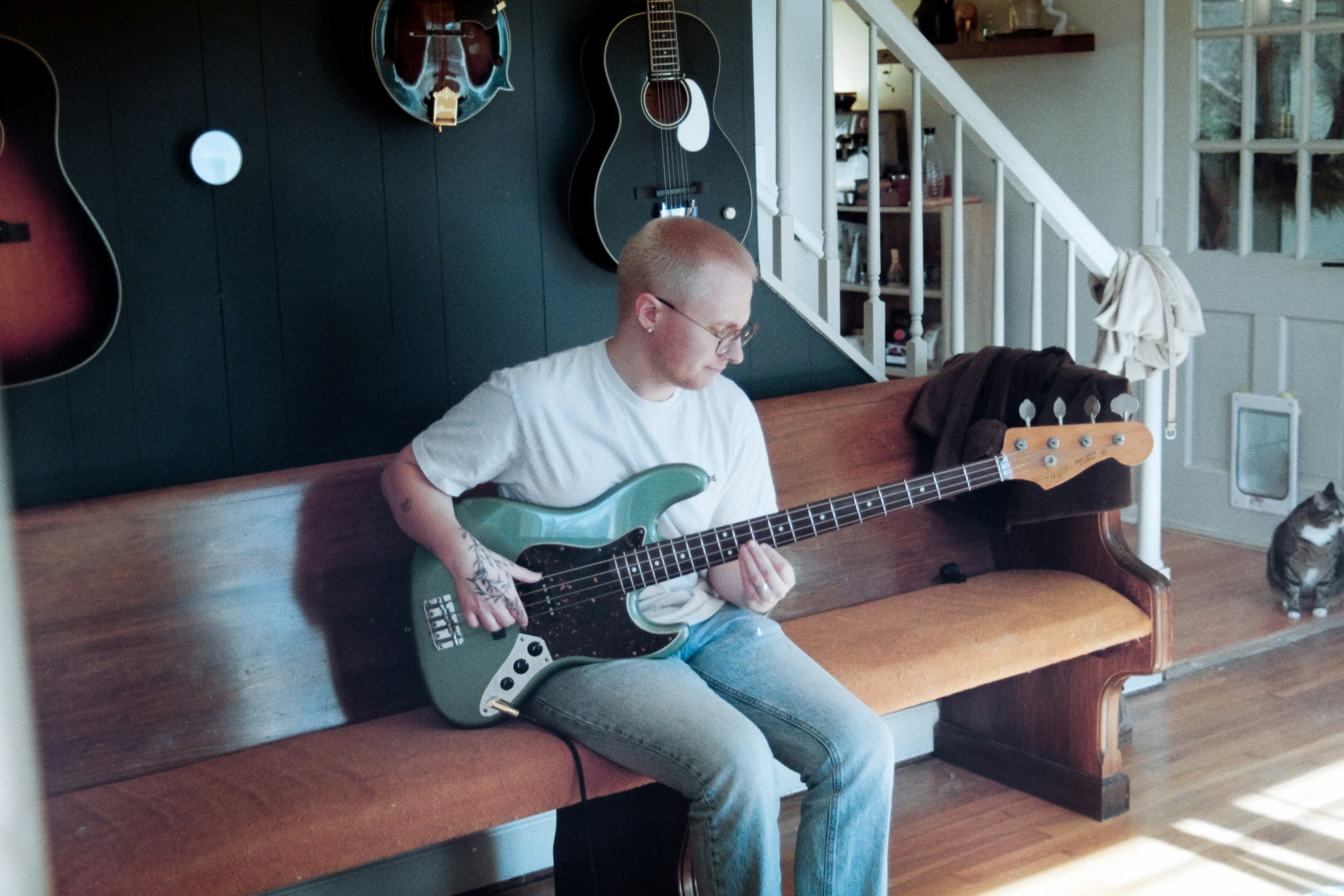
For musicians, this creates a challenging situation. Playing most instruments requires sitting, often in positions that are inherently flexion-biased — the forward reach of a pianist's arms, the forward head position of a violinist, the slight forward lean of a guitarist. These positions all load the disc in precisely the direction that aggravates an active herniation.
A musician with a lumbar disc herniation often describes their pain as tolerable at the start of a practice session and progressively worsening over time. By the end of an hour, they may be shifting constantly, standing up between pieces, or stopping altogether. The pattern is consistent: sustained sitting accumulates load, and load accumulates symptoms. In an acute disc herniation, sitting may not be tolerated for any length of time.
How this feels in practice
Musicians with disc-related sitting intolerance typically describe some or all of the following:
Pain that builds gradually over the course of a sitting session, rather than being present immediately, unless the herniation is acute—then the pain will be immediate and often intolerable
Relief with standing, walking on flat ground, or lying down — positions that decompress the disc
Pain that may radiate into one leg, particularly with prolonged sitting or certain trunk positions
Morning pain & stiffness that improves once they get moving
Discomfort with forward bending — bowing, reaching toward the keyboard, playing while sitting on a couch or supportive chair, or adjusting instrument position
Worsening symptoms after sitting at a desk, driving, or other non-playing activities that compound the load
What helps — and what doesn't
The most important thing to understand about disc herniations is that the majority resolve conservatively — that is, without surgery. A meta-analysis of cohort studies found that spontaneous resorption of herniated disc material occurs in approximately 66% of cases managed conservatively, with disc extrusions and sequestrations showing the highest rates of complete resolution.4,5 The body has a remarkable capacity to resorb herniated disc material, particularly when the mechanical environment is well-managed and loading is modified appropriately. It is important to be patient and recognize that the healing process can take up to 12-18 months to fully resolve. Realistic expectations and understanding of healing timelines are crucial to mitigate fear & catastrophic thinking. Though challenging and uncomfortable, it is normal to experience pain continuing for a year and a half. The symptoms will slowly improve over that period of time and you will not be in acute pain the entire time. Take a deep breath and trust in your body to heal. It can do remarkable things with a little bit of patience!
Physical therapy for disc-related sitting intolerance focuses on several things. First is identifying which positions and movements centralize or reduce symptoms — that is, which directions of movement pull pain out of the leg and back toward the center of the spine, which is generally a favorable sign. For many disc herniations, extension-biased movement and positions counteract the flexion loading that provoked symptoms in the first place.
The second focus is building the muscular endurance and control necessary to maintain a more neutral spinal position during sitting — reducing the posterior disc pressure that accumulated posture creates. For musicians, this means specifically training the ability to maintain neutral lumbar position while playing, which is a complex motor task that needs to be explicitly practiced.
The third focus is activity modification — working with you to find the instrument position, chair height, seating support, and practice schedule modifications that allow you to keep playing while the disc recovers. Complete rest is rarely necessary or helpful. Strategic modification almost always is.
Cause 2: Lumbar Segmental Instability
Lumbar segmental instability is less well-known than disc herniation but equally important — and frequently misunderstood, even within healthcare. It refers to a condition in which one or more spinal segments have lost their ability to control movement within their normal range, leading to excessive or erratic motion at that level under ordinary physiological loads.
The spine's stability depends on three interacting systems: the passive system (discs, ligaments, facet joints, and bone), the active system (muscles and tendons), and the neural control system (the nervous system's ability to coordinate the other two).6 When the passive system is compromised — through disc degeneration, ligament laxity, or facet joint dysfunction — the active and neural systems must work harder to compensate. When they cannot compensate adequately, the result is instability: excessive, poorly controlled movement at the affected segment that produces pain, particularly under sustained loading or during transitional movements.
Why sitting makes instability worse — but differently
The experience of sitting with lumbar instability is distinct from disc pain, though it can be easy to confuse the two. With instability, the problem is not primarily one of compressive loading on a herniated disc — it's the spine's inability to maintain a controlled position under sustained load.
O'Sullivan's foundational work on lumbar segmental instability identified sustained sitting, sustained standing, and sustained slight flexion in standing as the most commonly reported postural complaints in this population — with symptoms displaying and worsening within the neutral zone of the motion segment rather than at end range.7 However, clinically, I have noticed sustained extension as also being a common trigger—such as my violinists who sit too erect with an anteriorly tilted pelvis for sustained periods of time. I believe this can result in some shearing at lower lumbar joints causing pain and irritation. As sitting continues in either non-neutral spinal posture, the deep stabilizing muscles — particularly the multifidus and transversus abdominis — fatigue. These muscles are responsible for fine-tuning segmental control, and they are susceptible to inhibition from pain and deconditioning.2 As they fatigue, the passive structures must absorb more of the stabilizing load. In an already compromised passive system, this leads to increased segmental movement, increased stress on surrounding tissues, and escalating pain.
The other provocative scenario for instability is the transition — getting up from sitting, shifting position, moving from sitting to standing. These are precisely the moments when the stabilizing system must rapidly adapt, and for a patient with instability, these transitions can be the most painful moments of all.
Musicians with lumbar instability often describe a sensation of their back "giving way," "catching," or feeling unreliable — particularly when getting up from the chair between movements, adjusting their seated position, or moving quickly. Research has confirmed that patients with lumbar segmental instability demonstrate significantly greater difficulty accurately repositioning their lumbar spine into a neutral posture while seated, reflecting deficiencies in proprioceptive awareness specific to this population.8
How this feels in practice
Musicians with instability-related sitting intolerance tend to describe a different pattern from disc pain:
Pain or discomfort that may be present relatively quickly into a sitting session, rather than building gradually
A sense of the back "not holding," "giving way," or "catching" — particularly when shifting position 9
Pain with transitional movements — standing up from a chair, turning to adjust a music stand, getting in and out of a car
A tendency to self-brace — gripping the chair arms, tensing the core excessively, or sitting very rigidly — as a compensatory strategy
Relief with movement rather than rest — moving around often feels better than sitting still
A history of recurring low back pain that resolves and returns rather than following a clear progressive pattern
What helps — and what doesn't
The cornerstone of treatment for lumbar instability is neuromuscular rehabilitation — specifically, retraining the deep segmental stabilizers to activate appropriately, at the right time, and with the right amount of force. This is a much more specific task than general core strengthening, and it's one of the areas where physical therapy has a genuinely strong evidence base.
The multifidus and transversus abdominis often become inhibited or delayed in their firing patterns in people with chronic low back pain and instability. Research has demonstrated that simply strengthening the global musculature — sit-ups, planks, general abdominal work — is not sufficient to restore deep segmental control. Specific exercises directed at activating the multifidus aim not simply at strengthening the muscle but at restoring appropriate neural control and motor timing.7
For musicians, this means ultimately training stability in the postures and positions of playing — seated at the instrument, in the specific trunk and upper extremity positions their instrument demands. A stabilization program that doesn't account for the demands of performance is incomplete rehabilitation for a musician.
Manual therapy also plays a role in instability — not to mobilize the unstable segment, which would be counterproductive, but to address compensatory stiffness and dysfunction at adjacent levels and to reduce the pain that is inhibiting the local stabilizers from functioning normally.
How Do You Know Which One You Have?
Without a thorough clinical examination, it's often difficult to tell — and sometimes the two coexist, since disc herniation and segmental instability frequently occur together as part of the same degenerative process.
Disc Herniation — Common Signs
Pain builds gradually with prolonged sitting
Radiating leg pain, numbness, or tingling
Relief with standing or walking
Worse with forward bending
Often better lying down
Clear mechanism of onset
Lumbar Instability — Common Signs
Pain with transitional movements
Sensation of "giving way" or catching
Better with movement than rest
Recurring episodes of low back pain
Difficulty maintaining any one position
Self-bracing or excessive muscle guarding
A skilled physical therapist can distinguish between these presentations through detailed subjective history and specific clinical assessment — including movement analysis, provocative and relieving position testing, and hands-on assessment of segmental mobility and motor control. Imaging can be helpful but is not always necessary, and imaging findings don't always correlate with symptoms. What matters clinically is the pattern of symptoms, the response to specific movements and positions, and the findings on examination.
A Note for Musicians Specifically
There are a few things that make spinal pain in musicians particularly challenging — and particularly worth addressing with a provider who understands your world.
First, the demands of playing are highly specific. The seated posture of a violinist is different from that of a pianist, which is different from that of a guitarist or a percussionist. Rehabilitation that doesn't account for the specific postural demands of your instrument, your chair height and setup, and the duration and intensity of your practice schedule will leave gaps.
Second, the consequences of getting it wrong are high. A general patient who pushes too hard in sitting might have a bad day at the office. A musician who pushes too hard might miss a performance, lose a teaching position, or find that the thing they love most is becoming associated with pain and dread. That emotional dimension matters, and it influences recovery in ways that a purely biomechanical approach misses.
Third — and most importantly — you don't have to choose between playing and taking care of your spine. The goal of physical therapy for musician spinal pain is never to stop you playing. It is to find a path through rehabilitation that keeps you as connected to your instrument as possible while giving your spine the conditions it needs to recover.
The bottom line
Poor sitting tolerance in musicians is almost always addressable — but the approach depends entirely on what's driving it. Disc herniation and lumbar instability look similar from the outside but require different rehabilitation strategies. Getting an accurate diagnosis and a treatment plan tailored to both your spine and your instrument is the difference between managing the problem and actually resolving it.
References
Gnat R, Plandowska M, Madej J, Kiszka B, Sobota G. Differences in lumbar spine intradiscal pressure between standing and sitting postures: a comprehensive literature review. PeerJ. 2023;11:e16176. doi:10.7717/peerj.16176
Panjabi MM. The stabilizing system of the spine. Part I. Function, dysfunction, adaptation, and enhancement. J Spinal Disord. 1992;5(4):383-389. doi:10.1097/00002517-199212000-00001
Nachemson AL. Disc pressure measurements. Spine. 1981;6(1):93-97. doi:10.1097/00007632-198101000-00020
Zhong M, Liu JT, Jiang H, et al. Incidence of spontaneous resorption of lumbar disc herniation: a meta-analysis. Pain Physician. 2017;20(1):E45-E52.
Chiu CC, Chuang TY, Chang KH, Wu CH, Lin PW, Hsu WY. The probability of spontaneous regression of lumbar herniated disc: a systematic review. Clin Rehabil. 2015;29(2):184-195. doi:10.1177/0269215514540919
Panjabi MM. The stabilizing system of the spine. Part II. Neutral zone and instability hypothesis. J Spinal Disord. 1992;5(4):390-396. doi:10.1097/00002517-199212000-00002
O'Sullivan PB. Lumbar segmental 'instability': clinical presentation and specific stabilizing exercise management. Man Ther. 2000;5(1):2-12. doi:10.1054/math.1999.0213
O'Sullivan PB, Burnett A, Floyd AN, et al. Lumbar repositioning deficit in a specific low back pain population. Spine. 2003;28(10):1074-1079. doi:10.1097/01.BRS.0000061987.03467.F8
Yeomans SG, Naso C, Pitkanen M, Buttermann G, Liebenson C. Subjective and objective descriptors of clinical lumbar spine instability: a Delphi study. Man Ther. 2005;10(3):177-185. doi:10.1016/j.math.2005.01.002
Struggling to Sit Through a Practice Session?
If back pain is shortening your rehearsals, disrupting your focus, or making performances feel like an endurance test, I'd love to help. As a physical therapist and fellow musician, I understand both the clinical picture and the real-world demands of playing through it. Let's figure out what's driving your pain — and build a plan that gets you back to playing fully and comfortably.